By Aida Aydinyan
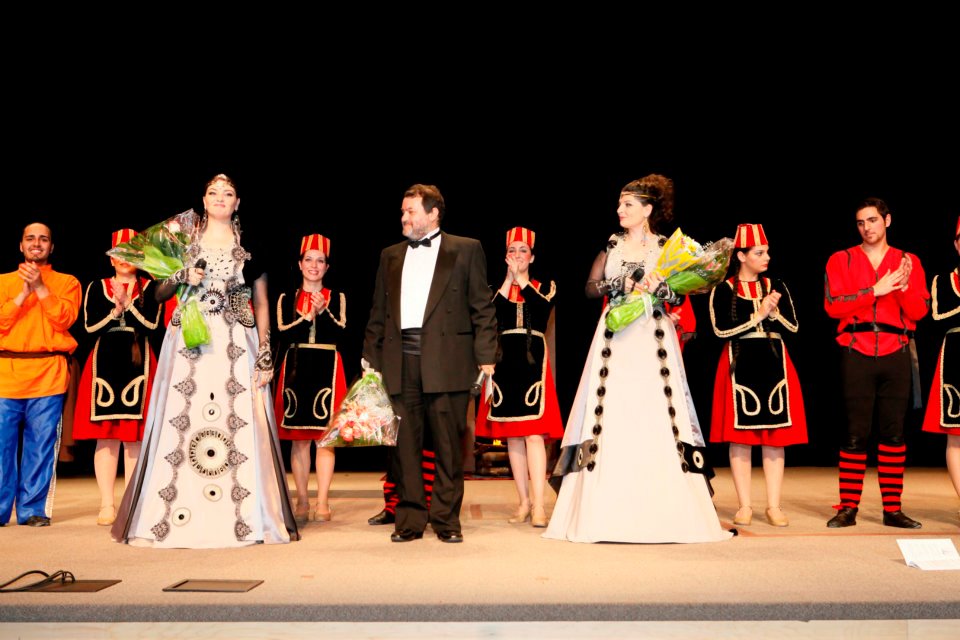 Toronto, ON – The Canadian Armenian Association for the Performing Arts (CAAPA) and the Armenian Association of Toronto (AAT) jointly presented the acclaimed Armenian duo of Inga and Anush Arshakyans and the Sassoun Dance Ensemble on Friday May 4, 2012, 8:00 p.m. to over 1,200 audience members.
The concert was organized under the auspices of the Armenian Diocese of Canada,
His Eminence Bishop Bagrat Galstanian and the Ambassador of the Republic of Armenia to Canada, His Excellency Mr. Armen Yeganian.
The show delivered what it promised – a magnificent celebration of Artsakh’s independence and 20th Anniversary of the liberation of the ancient capital city of Shushi. All the components were in place for a memorable evening: a packed house, CAAPA and AAT’s organized staff under Lena Ouzounian, Vaheh & Anabel Satourian’s leadership, energetic volunteers, lively young dancers, and of course, the apex of the show – the exceptional Armenian duo of Inga and Anush Arshakyan.
As guests walked into the auditorium, they were greeted by members of the Sassoun Dance Ensemble. They received concert programs with inserted flags of Artsakh and were ushered to their seats by the volunteers. The concert began with Robert Amirkhanyan’s Eraz Im Erkir playing in the background and a slideshow presented on both sides of the room on big monitors with pictures recollecting Shushi’s liberation. This patriotic opening presented a powerful beginning that set the stage for the next three hours of an exhilarating program.
The Arshakyan sisters pulled everything together with forms of music that reflected the depth and diversity of the Armenian story by bringing new life to folk melodies. The duo has been recognized as one of Armenia’s leading and innovative ensembles for their contemporary adaptations and interpretations of traditional Armenian music, receiving rave reviews from audiences and musicians alike, as well as representing Armenia brilliantly on national and international stages.
Inga and Anush have been singing and composing since childhood. They have been performing jointly on the professional stage since 2000. The music they offered was a fusion of Armenian folk music, jazz and other genres of contemporary music performed with exceptionally strong voices.
The duo’s dazzling and high-spirited program was an expression of Armenia’s rich heritage, culture and creativity. The show featured the songs Harsanekan, Tamzara, Sarer, Vortegh Es, Kilikia, My Name is Armenia, My Love Yerevan, Jan-Jan, as well as songs by Komitas and highlighted renowned music director and composer Armen Martirosyan and the Sassoun Dance Ensemble, under the artistic direction of choreographers Joe and Sossy Avakian.
Almost theatrical dance repertory of the Sassoun ensemble exhibited scenes from the Artsakh village, with silky and gliding female dance patterns blended with rustic bravura of male circle dances. These pictorial scenes were masterfully integrated into the program and added yet another layer of Armenian flare and poetic lyricism.
The concert was a pure blend of enchanting Armenian live ethno music and authentic dance. It contained an intriguing and exquisite set of carefully selected melodies. It combined sturdy and powerful patriotic songs with delicate and haunting a capella pieces with their drifting and charming arrangements.
Strong classical training did come through and the Arshakyan sisters complimented each other’s voices with personalities as amazing as their talents. Very often, we witness musicians with bold showmanship, but not much inborn talent; or the opposite, subtle talent, but not enough expressiveness. Inga and Anush achieved an exquisite balance between showmanship and instinctive musicality; their voices were passionate yet delicate, powerful and fragile at the same time, with just enough thrill and restraint.
It was a professionally-staged and tasteful production. The entire auditorium was completely mesmerized by the Arshakyan sisters and by the waves of joyful and sad, romantic and patriotic, ethnic and contemporary songs floating the auditorium. The excitement was palpable as close to 1,200 spectators enthusiastically applauded and cheered the performers song after song.
It was an emotional and memorable evening for me for many reasons. It reminded me of our difficult past and promising future. I am a grandchild of a Shushi genocide survivor. My grandfather, Abraham Aydinyan was forced to flee Shushi with his sister in March of 1920. His house and massive library were burned. He lost most of his family, his brothers and sisters to pogroms and mass killings.
My grandfather’s Shushi was home to many intellectuals, poets, writers and, especially, musicians. He was born in a city which was the most important industrial, commercial, cultural and educational center in the Caucasus at the time. My grandfather himself was a writer, editor, translator and historian. He was an editor of one of the 20 Armenian newspapers published in Shushi at that time with their own printing house. He translated fables, legends and fairy-tales from eight languages. He believed that the Nation’s fairy-tales contained its creative DNA and represented its collective dreams and inspirations.
I grew up with my grandfather’s beautiful fables, stories and fairy-tales. And the most beautiful fable of all was about Her Majesty Shushi, the heart and soul of Artsakh. I heard so much about Shushi that when I visited the city for the first time, while it was still in the ruins, with a Giumry local TV production team of three, I felt I had already been there and seen the beautiful city.
I felt I had seen the invincible fort, the mulberry gardens, the Ghazanchetsots Cathedral, the town bathhouse and the town shuka, the rectangular limestone houses with side-balconies, patterned metal windows and sloping roofs, the carpet-weaving and silk production quarters, blacksmiths shops and bakeries, and the Armenian club where my grandfather and Shushinians watched Vahram Papazyan play Othello and Hamlet in Armenian in 1917.
The pain of loss never left my grandfather and he died with the beautiful image of Shushi in his eyes. I returned from my Artshakh trip proud and inspired with a handful of sacred soil and a bottle of spring water for my grandfather’s gravestone from his majestic Shushi. I wish he could see his Shushi free and reborn. I am sure he would have loved to tell that story. For the first time in our nation’s history our tale ended with “…happily ever after.”
For Armenians young and old, for Armenians from the past and of the future, for Armenians at home and around the world striving to preserve our heritage and culture, searching for identity and sacrificing for a letter tomorrow – Shushi is a beacon of hope – a living, breathing true fairy- tale of what is possible when we unite for a common cause and purpose.
By the time Inga and Anush Arshakyan, Armen Martirosyan and the Sassoun Dance Ensemble performed the culminating piece, Mer Anunn E Haykakan Banak, the festive cheering and clapping crowd was on its feet to give the performers a lengthy standing ovation.
“In our concerts either at home or abroad we try to connect with our audience and convey positive energy, which is contagious and which multiplies with every song,” said Inga Arshakyan and continued – “As the end of the concert approaches, that positive, life-affirming energy culminates and has the power to transcend any barriers, including time and distance, it resonates with people long after the performance ends. Our ultimate goal is to create that magical connection”.
“We hope that we’ve given people something to not only enjoy but also to be proud of while creating a pleasing concert-going experience,” pointed out CAAPA President, Lena Ouzounian. “We also genuinely hope that the show attracted the attention of the eyes, the ears and the hearts of 1,200 attendees” added AAT President, Vaheh Satourian.
The organizers were determined to ensure a packed auditorium and a memorable experience. The concert indeed caught not only the eyes of the spectators, but also their hearts. It was a beautiful tribute to our hard-fought liberation, a tribute to our grandparents, who kept our stories alive for us; to General Arkadi Ter-Tadevosyan, the mastermind behind Shushi’s liberation and the “Wedding in the Mountain” brilliant military operation; to all our brave martyrs, who gave their lives to liberate Shushi and for their invincible spirit, profound faith, vision and supreme sacrifices. And last but not least a tribute to our young Armenians living in Shushi today who one day will tell their grandchildren the old and new fairy-tale of the beautiful city of Shushi.